Self-Supervised Ensemble Learning for Skin Lesion Classification (HAM10000)
About the Project
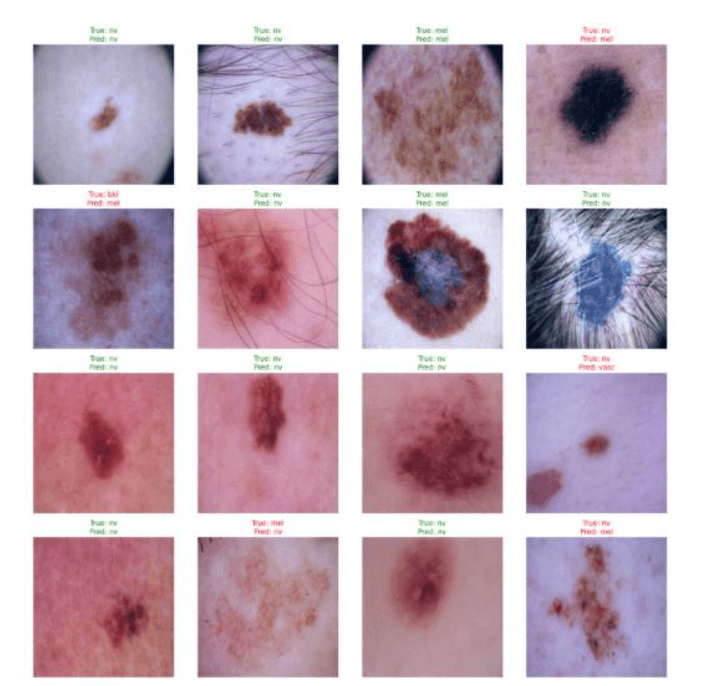
This research-oriented project addresses the challenge of training accurate skin lesion classifiers when labeled medical data is scarce. It leverages self-supervised pretraining (SimCLR) to learn rich image representations from unlabeled dermoscopy images, then fine-tunes multiple deep learning backbones (EfficientNet, ResNet) on the HAM10000 dataset. An ensemble strategy combines predictions from these models, significantly improving robustness and accuracy across all 7 lesion categories including melanoma, basal cell carcinoma, and actinic keratosis.
⚡ Challenges Faced
- Class imbalance in the HAM10000 dataset required aggressive oversampling and class-weighted loss functions to prevent models from ignoring minority classes.
- Self-supervised pretraining is computationally intensive — required careful management of GPU memory and training schedules.
- Tuning the ensemble weighting strategy to maximize macro-averaged F1 across all 7 classes rather than overall accuracy was non-trivial.
🚀 Future Plans & Improvements
- Publish findings as a research paper and evaluate on additional dermatology benchmark datasets.
- Integrate GradCAM heatmaps so clinicians can visualize which skin regions influenced each prediction.
- Build a clinical-facing web interface that accepts dermoscopy image uploads and returns classification results with confidence scores.